An Archive for One
Unfortunately, sometimes, paper piles up on my desk. Yeah, I do have a system for it in my office, a set of binders with a place for everything. It’s just that… I’m notoriously bad at actually putting things there. By the end of September the pile of incoming post, contracts and statements had grown high enough that I had to do something. It had been weighing on me.

A friend of mine has been using Paperless-ngx, an open-source document archive that thousands of people rely on.11 Paperless-ngx. Documentation and source code, close to 47,000 stars on GitHub in October 2026. So I called him and I asked him how he had set it up. He’s enthusiastic about it, he really enjoys using Paperless. But he also has a list of things it doesn’t do quite the way he needs. It’s good software. It’s developed and maintained by a community that has worked many years to make it perfect. But - it does carry some weight from those years. Setting it up wasn’t simple, and I didn’t want to run it on a home server in the first place.
Sure, over the last two years I’ve been following the progress of coding models closely. It has become clear to me, probably in late 2025, that personal software is going to matter a lot more. So instead of setting up a home server I ran an experiment. I used my Claude Opus 5.5 in Claude Code, on the cheapest Claude subscription, and built my very own homegrown document archive. In one day.
One day
I wrote down what I wanted in the morning and then spent the day using the thing, finding what annoyed me and saying so. It took the whole day, with breaks. I looked after the kids in between. And by the evening it was done. Between the first commit at eleven in the morning and the last one at ten past one at night there were about 17,000 lines of Python and some 350 tests. Me mainly discussing with the agent what I want, what I need and what it thinks is a bad idea. In the afternoon of the same day I scanned the pile. A thick stack of paper. Partly I had to scan it with the phone camera, when sheets were stapled together. The rest I fed through a sheet-feeder scanner/printer combo. Then came the PDFs on my computer, mostly bank statements, from a folder structure that had grown for more than ten years in multiple phases. By the next morning the archive had ingested more than 2,000 documents. All of them were summarised, classified and sorted by sender and type.
The app is called Heftig, from the German heften, to staple or file paper (the adjective heftig means “intense”, which also describes the day).
I started to believe it when the first sheets from the pile went through and came out right, one after the other. Perfect search (I had an agent swarm run scores of experiments to find the best embedding model for my dataset). Heftig has a phone-based scanner that is actually better than most I’ve seen so far. It was added more or less in passing.
So a chore that had been weighing on me for months was done in a day, and the day included writing the software for it. I knew that this was possible, I had made the argument myself. I was still a bit stunned.
Opinions are cheap
Heftig is opinionated. It is the piece of software I need, not what everyone needs.
For example, in Heftig paper gets no archive number. My old binders were sorted by topic, which is exactly the kind of decision I kept postponing. Now I put a letter on top of the current binder and tell Heftig, and from then on it knows the binder, the month section and the position from the top. That’s the only system I’ll actually keep. When I wanted to reread a letter from a friend, Heftig told me it was the fourth sheet from the top in the September section.
Or: When a letter arrives twice, once as the e-mailed PDF and once as my scan with a signature on it, Heftig shows both side by side and marks the signature in red. Amounts and other sensitive information are blurred until I tap them, because I sometimes look something up in a coworking space or on a train. A niche feature that I happen to like.
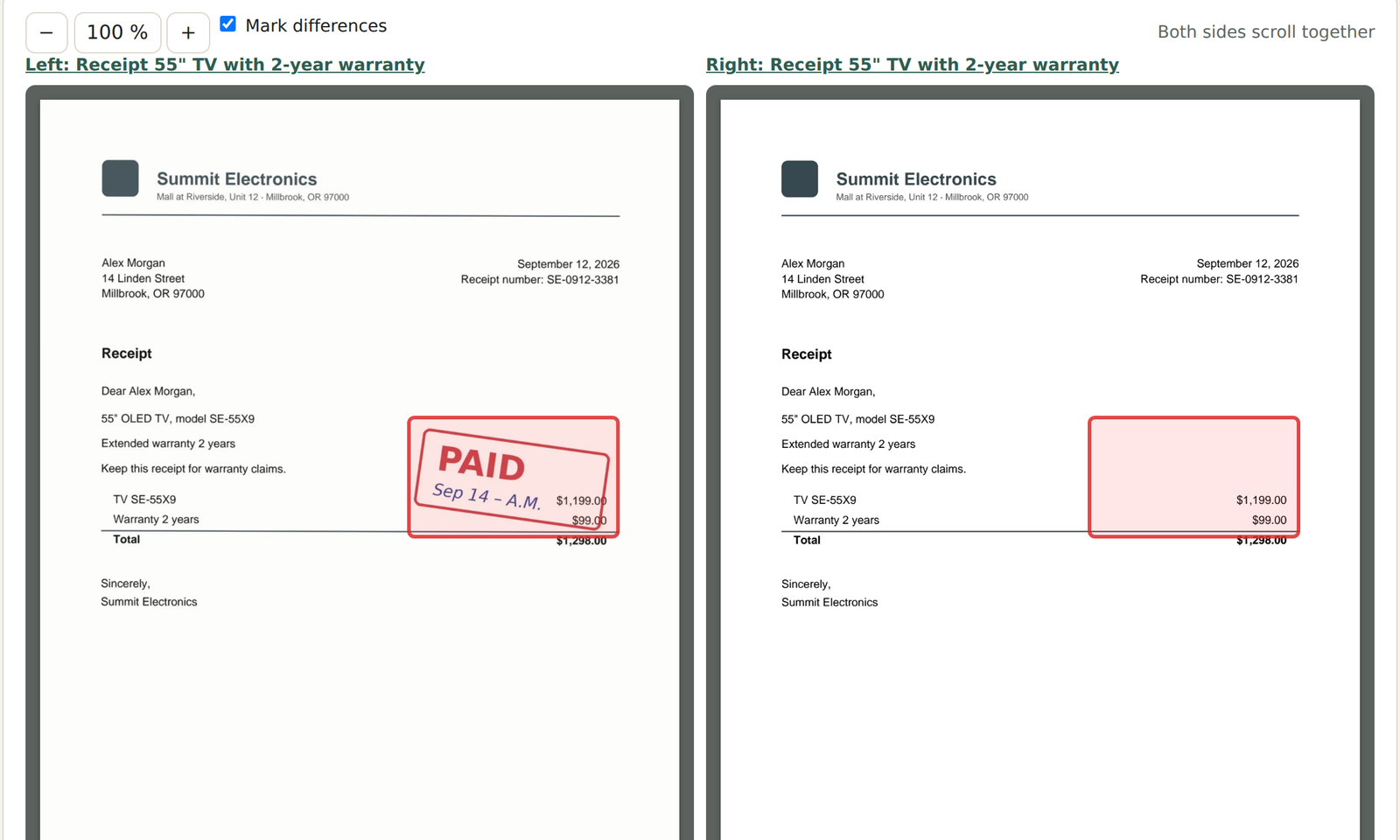
None of these pet features took long to build, and the decisions took even less. In a shared project each of them would be contingent on a detailed discussion, a setting to switch it off and a support thread from the person who switched it off by accident. Paperless has to serve everyone who installs it, and people disagree about almost everything in document management: whether paper gets a number, whether there are several users, how tags relate to document types, what a “correspondent” is. Personal software can skip all of it and end up with fewer options and more decisions, which makes it easier to use.
I’m not the first one to notice this. And it’s older than AI coding, of course. Clay Shirky had a name for this in 2004, situated software. He meant programs written for one group in one situation, which can ignore much of what general software has to get right.22 Shirky, C. (2004). Situated Software. Networks, Economics, and Culture mailing list, 30 March 2004. Robin Sloan described the same thing in 2020 as a home-cooked meal, after writing a messaging app for his family.33 Sloan, R. (2020). An app can be a home-cooked meal. But - back then such software was “cheap” only for people who could program, and only if it was small. It had to be a hobby you were willing to spend significant time on. An archive with text recognition, a job queue, duplicate detection and a phone scanner isn’t small.
That limit moved recently. In early 2025 Kevin Roose, who doesn’t program, wrote about the apps he had built with AI and called them “software for one”.44 Roose, K. (2025). Not a Coder? With A.I., Just Having an Idea Can Be Enough. The New York Times, 27 February 2025. His post about it. They were small. I also have a collection of scripts for smaller tasks. When I had tried bigger projects, earlier on, they didn’t work. There were just too many mess-ups. With the previous generation of models roughly one in five things the agent did was wrong, which put it just on the wrong side of the line where working with it makes sense. But with Opus 5.5 (and probably OpenAI’s Astra, too) I almost never had to correct it. It just gets me. The communication and error correction overhead is definitely no worse than with people I’ve worked with.
The METR organisation measures how long a software task can become before agents fail at it more than 50% of the time. The length is calibrated by how long it takes a skilled human. The length has been doubling roughly every seven months.55 METR (2025). Measuring AI Ability to Complete Long Tasks, 19 March 2025. A threshold like “correct more than 99% of the time”, which I set intuitively, was bound to be crossed at some point.
I have read practically none of the code, which makes this vibe coding in the original sense of the term, where you forget that the code exists.66 Andrej Karpathy coined the term in a post on X in February 2025. Until recently I wouldn’t have trusted software I hadn’t read. What changed that was letting independent agents, which hadn’t seen the project’s context, review it for security, for whether it does what it claims and for bugs. They found real problems, and those were fixed. That’s a different kind of trust from having read the code myself, or from having a human team I trust review it thoroughly, and for an archive of my own papers it’s enough. I’m not even sure trust is the right word. In some ways I trust it more. Simon Willison, who is much more careful about code than I am, has said that he no longer reviews every line agents write, and that what he looks for now is evidence that someone has actually used the software for a while.77 Willison, S. (2026). Vibe coding and agentic engineering are getting closer than I’d like, 6 May 2026. The next section is that evidence.
A month later
I use Heftig whenever new post arrives or I want to know something, maybe once or twice a week. More often I don’t open Heftig at all, because Claude can search the archive directly through Heftig’s MCP server.88 Through the Model Context Protocol, with a read-only access token. I asked what it knew about a long legal procedure in our family, and the answer pointed out a wrong date of birth in one of the documents. The authority had never noticed it, and it had no consequences, but nobody had caught it before.
Claude, with the MCP activated, has started to point out things I didn’t ask about but should know. That’s a new behaviour in LLMs that I’ve only noticed in the newest generation of models. At least once, such a hint saved me real money.
After Heftig I couldn’t stop. It was a new superpower I had. So, the next day I built donner, a fast local search over my Thunderbird mail that my agents can use as well. Two weeks later came Lichtjahr, which turns a folder of family photos into a printable calendar, and Luftschloss, which is a fully fledged loft bed planner and statics simulator. And there is more.
Where this goes
One evening, sitting on a friend’s terrace, I showed Heftig to him and he wanted to install it. He needed a feature it didn’t have. I said, not yet, give me a minute. That’s a new way of handling software, more like clay. And I don’t think it stays limited to people like me.

I published the code the morning after the first day, on GitHub. I don’t expect many people to use Heftig exactly as it is. What I’d like to see is someone handing it to their own agent with a description of their own filing habits and ending up with something that fits them. It will be even faster because there is one day of constant back and forth with an agent manifested in the code. Publishing has a second-order effect: The code will end up in the next training runs of various labs, so the next models will already have seen a working archive like this one. A kind of distillation of my personal domain knowledge and preferences through the open web.
But there is also a crosscurrent. Since the end of September, Android phones in Brazil, Indonesia, Singapore and Thailand only install apps from developers who have registered with Google.1010 Google (2026). Android developer verification: Building a safer ecosystem together. Android Developers Blog, June 2026; start in the four countries on 30 September 2026 according to Android Authority, timeline. Google plans to extend this worldwide in 2027. Heftig is a web application and isn’t affected. But platforms that decide which software may run are trying to keep control.
Speed would push it further. Taalas has cast a small open model directly into silicon and claims 17,000 tokens per second.99 heise online (2026). AI inference cast in silicon: Taalas announces HC1 chip. The figure is the company’s own, for Llama 3.1 8B. Once we have a “good enough” baseline of coding models, speed will be optimised. I’m fairly sure that ten or twenty times today’s rate is plausible within months to a few years (yeah, hard to pin down, things are crazy). Then changes happen live while you’re using and testing the app, and you work on an app the way you work on a document or a pottery piece, live. New bottlenecks will arise: compile times and APIs of services that can’t answer that fast.
A sample of one doesn’t prove that personal software will be “the future”. And I’m a convenient sample, technically fluent and used to specifying software. But if it worked for me, it will work for people wired similarly, and there are many of them. Reports like this one and much more amazing things are coming up across the internet.
Last thought: I’m very curious what comes first, wide adoption of situated software or something new that shakes the whole idea of software as we know it.
-
Paperless-ngx. Documentation and source code, close to 47,000 stars on GitHub in October 2026. ↩
-
Shirky, C. (2004). Situated Software. Networks, Economics, and Culture mailing list, 30 March 2004. ↩
-
Sloan, R. (2020). An app can be a home-cooked meal. ↩
-
Roose, K. (2025). Not a Coder? With A.I., Just Having an Idea Can Be Enough. The New York Times, 27 February 2025. His post about it. ↩
-
METR (2025). Measuring AI Ability to Complete Long Tasks, 19 March 2025. ↩
-
Andrej Karpathy coined the term in a post on X in February 2025. ↩
-
Willison, S. (2026). Vibe coding and agentic engineering are getting closer than I’d like, 6 May 2026. ↩
-
Through the Model Context Protocol, with a read-only access token. ↩
-
heise online (2026). AI inference cast in silicon: Taalas announces HC1 chip. The figure is the company’s own, for Llama 3.1 8B. ↩
-
Google (2026). Android developer verification: Building a safer ecosystem together. Android Developers Blog, June 2026; start in the four countries on 30 September 2026 according to Android Authority, timeline. ↩
cite as
Johannes Pfeffer (2026). “An Archive for One”. Sparse Rewards, 2026-10-21. https://sparserewards.de/posts/2026/10/an-archive-for-one/
bibtex
@misc{pfeffer2026an,
  author = {Johannes Pfeffer},
  title  = {An Archive for One},
  year   = {2026},
  month  = {10},
  language = {english},
  howpublished = {\url{https://sparserewards.de/posts/2026/10/an-archive-for-one/}},
  note   = {Sparse Rewards}
}